

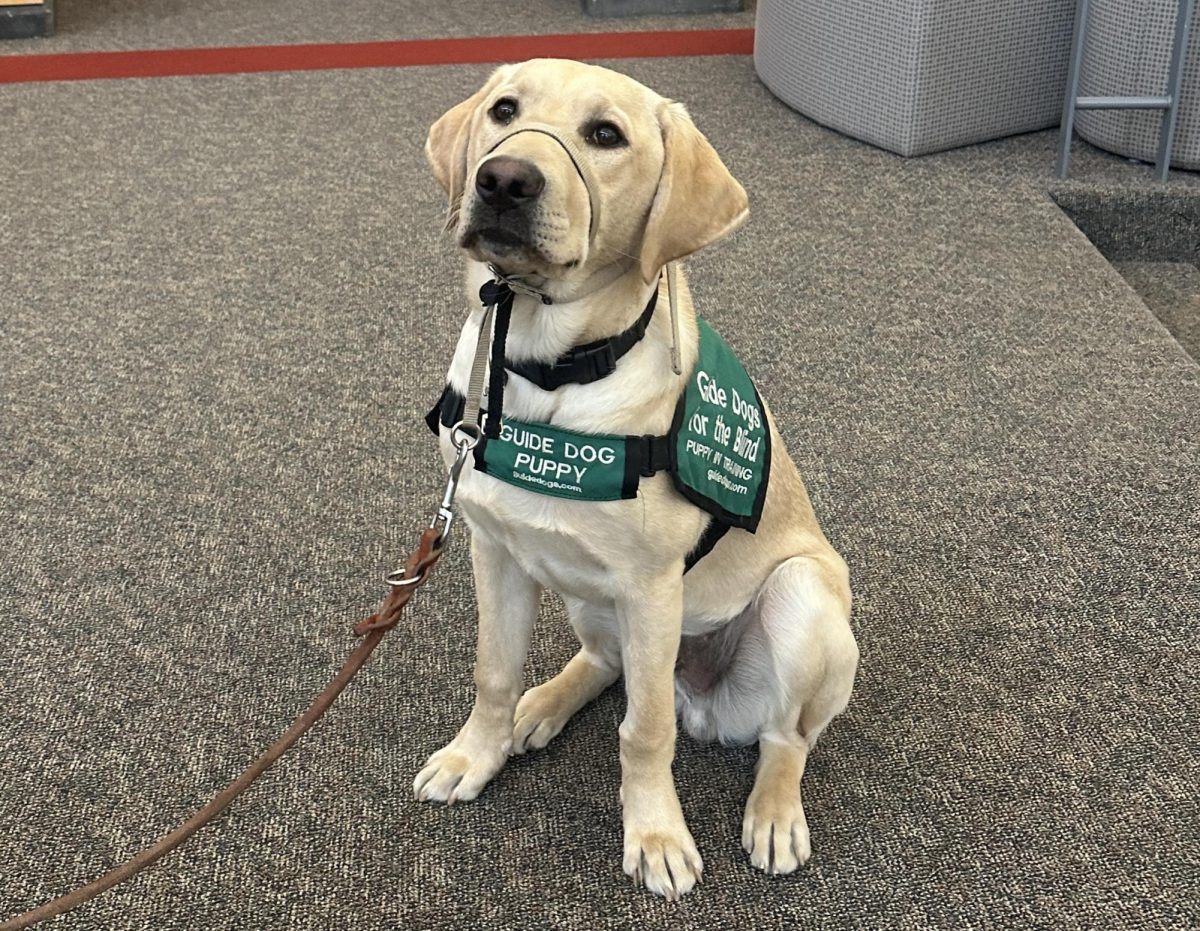
Among Fossil Ridge High School’s 1800 students is a four-legged student: a dog in training to assist the blind.
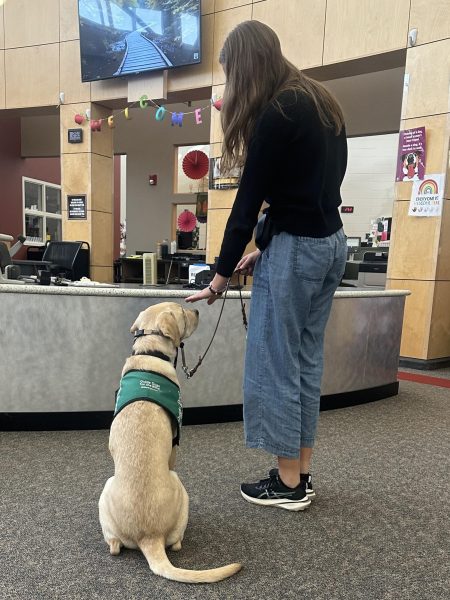
Seven-month-old Yarnell is training to be a guide dog for the blind with junior Isabelle Martine at Fossil. Martine and her mom volunteered for Guide Dogs for the Blind and have been able to train Yarnell at home and in some of Martine’s classes.
“Well, he’s a silly little goose,” she said about her dog. But the training is worth it.
“It’s a lot of time and effort. It is very rewarding, and it is a skill you can use in the future,” she added. ”I love it most days, but sometimes it’s hard.”
The process of training a guide dog to be starts when they are just two months old, when they are introduced to simple tricks and the bathroom command. Then, when they are four months old, they get gradually introduced into public spaces. Then, at 12-14 months, the time they are left alone gradually increases.
“We are called Puppy Raisers, and so we raise them to be good dogs. We introduce them to the world and make them calm inside it,” Martine said. “And then after the puppy raisers raise the puppy for 12 to 14 months, they go back to formal training in Oregon, and a professional trainer trains them to be an actual guide dog.”
(Mia Potter)
After leaving Puppy Raisers, the dogs go to formal training for four to six months before getting matched with someone by the home’s environment and the person’s needs.
Training a guide dog to-be can have many unique challenges, determined by the dog’s personality.
“A hard thing for him is distraction. He loves to look at everything and smell everything, and I think that will definitely be one of his issues continuing forward,” Martine said.
Martine’s chemistry teacher, Brian Riedel, loves having Yarnell around to light up the classroom.
“It’s not the first time that that’s happened, and usually they’re really well behaved, obviously. And I’m used to having a dog around. I have a dog of my own, and so they’re not a distraction to me at all, or at least not a negative distraction,” Riedel said.
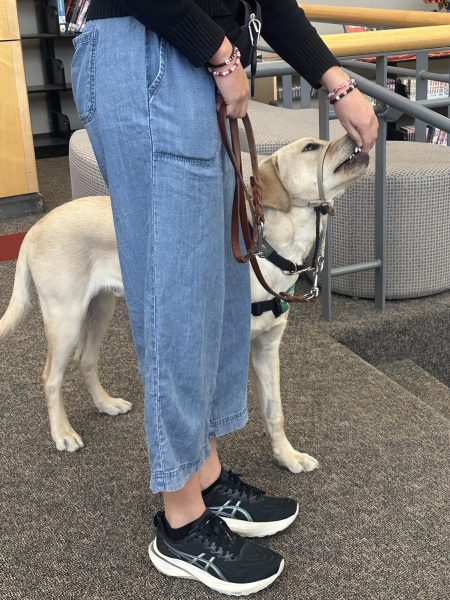
Along the way, Yarnell has taught Martine about his personality and the world around her.
(Mia Potter)
“I have learned about him that he needs to go slow, but he will work up to being confident enough. He loves to learn, he loves to impress. He wants to try his hardest. And he really wants to please people, probably because he gets food from that,’’ Martine said.
Martine has enjoyed the process of working with the dog.
“I think that it is really fun and really beneficial,” Martine said. “You learn a lot about the world and how it works and about yourself.”
Being able to train a guide dog to-be offers lessons in life that not many people get.
“I mean, for one thing, you get to have a dog with you. It’s a conversation starter,” Martine said. “You really learn a lot about the world and the dog and yourself. You get to have a special experience that not a lot of people have.”